All Pioneers (100)
← → keys to flip
Profile 21 of 100
Lifespan 1957–
Technical Depth advanced
Key Breakthrough ARM 32-Bit RISC Instruction Set Architecture (ARM1/ARM2) & BBC BASIC
Focus Areas
microprocessor architecture RISC design assembly systems embedded computing
Topic Keywords
#ARM
#processor-architecture
#microarchitecture
#RISC
#assembly
#VLSI
#BBC-Micro
Source: Historical Biographical Archive / Wikimedia Commons
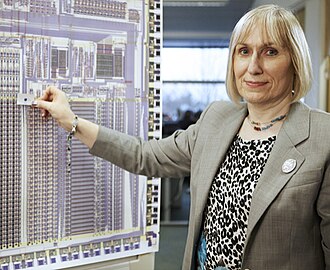
Sophie Wilson
Chief Architect of the ARM RISC Instruction Set & Acorn BBC Micro
Biographical Overview
Architected the original 32-bit ARM instruction set and wrote BBC BASIC. Wilson designed the load/store RISC architecture that runs on more than 280 billion chips worldwide, powering virtually all modern smartphones, tablets, and Apple Silicon chips.
"A good instruction set is like a well-designed language: simple to understand, elegant to compose, and fast to execute."
— Sophie Wilson
Key Technical Breakthroughs & Inventions
01
The 32-Bit ARM Instruction Set Architecture (1983–1985) Designed the instruction set for ARM1 and ARM2, pioneering architectural innovations including conditional execution for every instruction, single-cycle datapath barrel shifting, load/store multiple (LDM/STM) register operations, and high code density with just ~25,000 transistors.
02
Ultra-Low-Power RISC Paradigm Proved that streamlined microarchitectures with simplified instruction pipelines could outperform complex CISC processors (like the Intel 80286 and Motorola 68000) by a factor of 10x per watt, inaugurating mobile computing and battery-efficient silicon architecture.
03
BBC Microcomputer & BBC BASIC Assembly (1981) Designed the system architecture for the Acorn BBC Micro and wrote the entire BBC BASIC interpreter in hand-optimized 6502 assembly language, integrating an inline assembler and structured control flow that educated an entire generation of computer scientists.
04
FirePath VLIW SIMD Telecom Processors Co-founded Element 14 (acquired by Broadcom) and architected FirePath, a 64-bit dual-VLIW SIMD digital signal processor designed for high-density central office asymmetric DSL access multiplexers.
💡
Historical Context & Impact
In short
When the first prototype ARM1 silicon arrived in 1985, engineers accidentally left the chip's 5V power supply disconnected. The microprocessor kept executing instructions anyway—it consumed so little power that it ran entirely on minute leakage current flowing through its logic pins.